


AVR Atmega8 168 328 Min. Development Board

$3.20
- Description
- Additional information
- Reviews (2)
- Enquiry2
Description
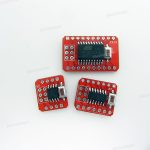
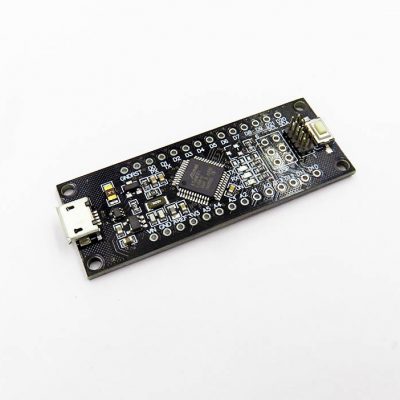
- All 23 IO pins leaded out.
- Classic ATmega8 minimum system, eliminating the hassle of soldering
- Crystal: The socket hole welding facilitate the buyer to replace the crystal, the default hair 8M crystal
- Power supply: ISP port or external pins, three channels of power supply on the pins.
- Reset: Power-on reset and reset button
- External expansion 4 led lights, convenient debugging
- Power LED (DS1)
- Standard ISP download interface, board do not need extra power supply, use directly ISP power.
- Tested by customer, can work with arduino IDE, uploading sketch is no problem
Documentation: Schematic avaialble on this link.
Additional information
| Weight | 0.04 kg |
|---|



![ATtiny13A – PU, 8P, 10MHz, 1K, 4A/D [DIP, SSOP]](https://www.electrodragon.com/wp-content/uploads/2012/01/attiny13-400x400.jpg)


![[Retired]AT89S51 - DIP 40, 4k Flash, 24PU](https://www.electrodragon.com/wp-content/uploads/2012/01/at89s51.jpg)


andy (verified owner) –
Great price. Both of mine have the 8MHz xtal in a socket, so it’s easy to replace with a 16MHz one.
The ZIF socket isn’t really needed, if all you want it for is to make a smaller version of an Uno, but it means it would make a good boatloader programmer, to put an Uno bootloader on a blank Atmega328P – see http://arduino.cc/en/Tutorial/ArduinoISP – you need an Uno board with the 328P removed, and some jumper wires and either a second Uno board, or a solderless breadboard, or one of these and an M-F DuPont cable. I think the ZIF socket on this makes it one of the better options for doing that.
kremen (verified owner) –
very handy unit.. i use it mainly for uploading the bootloader and setting fuses. also as a quick and simple test bed for projects.. 16MHz crystal option is nice..